
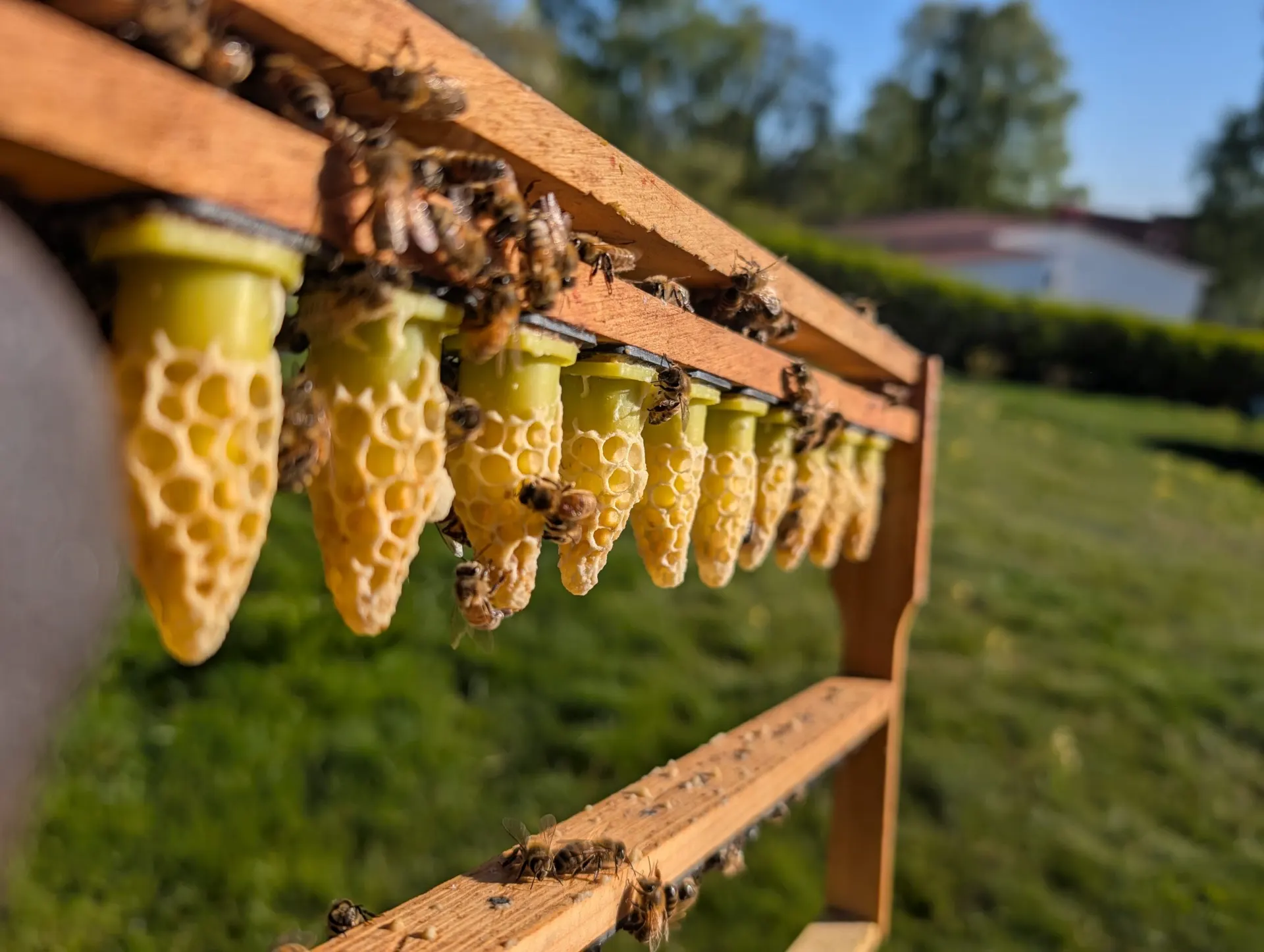
How to introduce a mated queen
Key information for successful queen introduction. Follow the steps in order – most failures come down to a missed queen cell or a colony with laying workers.
1. Preparation
- Timing: Open the hive gently, with minimal smoke. Ideally in the evening, once the foragers have settled down.
- Old queen: Remove her straight away.
- Waiting time: Leave the colony queenless for at least 2–4 hours before introduction.
2. Check for queen cells
Go through every frame. Destroy every queen cell – both open and capped. A single missed cell can lead to the new queen being killed immediately.
3. Food and health
If there is no nectar flow, feed sugar syrup well in advance. Never introduce a queen into a diseased colony or one with a high varroa load.
4. Placing the cage
- Water: Put a drop of clean water on the mesh with your finger just before inserting the cage – the queen may be dehydrated after the journey.
- Prepare the cage: Break off the plastic tab covering the candy. Leave the other plug in place (it prevents the queen from walking straight out).
- Position: Place the cage in the middle of the brood nest between the frames and secure it with a toothpick. The mesh should face the bees – this allows the scent to spread and the bees to feed her.
5. Checking acceptance
Day 1–2: check how the bees behave around the cage
✔ Good signs: The bees sit calmly and feed the queen, and build pale wax onto the cage – remove the second plug.
✘ Bad signs: The bees form a tight, aggressive ball around the cage or cover the mesh with propolis – wait another day. If the aggression continues, see section 7.
Day 5–7
Look for freshly laid eggs. Don’t move frames around unnecessarily.
Note: no eggs after 7 days? Wait another 3–4 days (cold weather delays laying). If she still isn’t laying, check whether the colony has laying workers (see section 6).
6. Long queenless or laying workers
Signs of laying workers: several eggs per cell, eggs on the cell walls, a patchy laying pattern.
- Without laying workers: Introduce as in sections 1–5, but expect a lower acceptance rate. It helps to add a frame of open brood at the same time as the cage – it triggers the bees’ nursing instinct and improves the chance of acceptance.
- With laying workers, direct introduction does not work. Keep the queen cage safe indoors (with a drop of water) and use the shake-out method below.
The shake-out method
- Carry the hive 50–100 m from its stand. Shake all the bees out onto the ground. The flying bees return home; the laying workers (which have lost their flight orientation) stay behind and die.
- Put the empty hive back on its original stand.
- Once the flying bees have returned, introduce the queen as in sections 1–5.
Warning: Putting the queen straight into a colony with laying workers almost certainly means losing her.
An alternative that keeps the colony at full strength is the Tjebuzdin brothers’ method.
7. If the bees refuse the queen
- Remove the cage immediately. Keep the queen safe (in a nuc, or indoors with a drop of water).
- Check: a missed queen cell? Another queen in the hive? Laying workers (see section 6)?
- Let the colony settle for 24–48 hours after the problem has been fixed.
Try again with the 6-day method
Put in a frame of open brood and the queen cage at the same time (day 0). On day 6, during the same inspection: destroy ALL queen cells on the frame – and immediately afterwards open the cage’s large compartment. Miss one cell and the queen is lost.
Tip: Check the amount of candy on day 6 – the bees may already have eaten it. Top it up if needed before opening the compartment.
★ The safest method: via a nuc
Make up a small nuc (2–3 frames of capped brood + young bees) and introduce the queen there. Once she is laying steadily, unite it with the main colony using the newspaper method. Almost 100% success.
Other safe options for valuable queens
- Over a double screen board (second storey): Put a box of capped brood on top, separated from the parent colony by a double screen board (which lets through air and scent but not bees). Turn the upper entrance to face the opposite way. Make sure there is good ventilation so the brood doesn’t overheat. Introduce the queen into the upper box.
- Push-in cage: Press a push-in cage (e.g. a round 90 mm one) into the comb over an area of emerging brood with a little stores. Release the queen under the cage. The newly emerged bees accept her immediately.
Good luck!
© 2026 Aleksei Pliusov, Guldbigård. This text may not be copied or published without permission.